
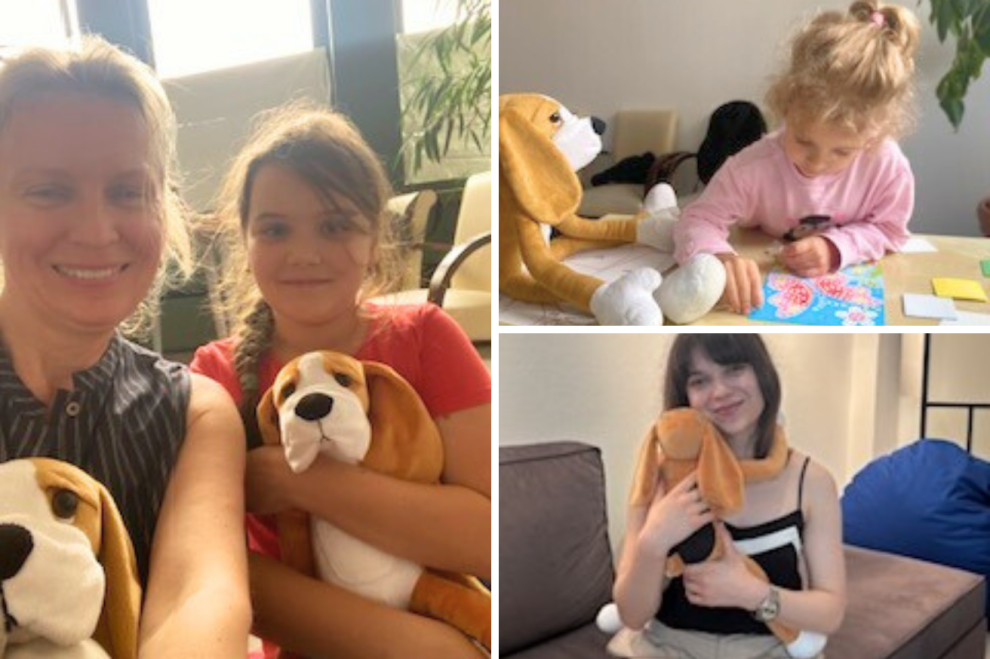
Mother-daughter trips don’t typically involve providing therapy to refugee children. But for Inna and Sophia Muntyan, they do.
The duo, based in New York, were initially driven to assist Ukrainian refugees after the 2022 Russian invasion. Both women speak Russian and Ukrainian; Inna also speaks Polish. At first, Inna and other community members raised money for Ukrainian families they knew, but they quickly found that these efforts weren’t effective because they couldn’t connect directly with refugees.
Luckily, their local Jewish Community Center (JCC) soon introduced them to Jewish Federations of North America’s Global Volunteer Hub (GVH).
Since its inception in 2022, when the program was created with initial co-anchor partners the Jewish Agency for Israel and the Joint Distribution Committee (JDC), the GVH has served as a one stop shop to match skilled North American volunteers with the language and professional skills needed to support Ukrainian refugees with partner organizations in Europe. Since the start of the full-scale war in Ukraine, over 300 volunteer placements have been facilitated with 21 partner organizations in 9 countries. These skilled Ukrainian and Russian-speaking skilled volunteers include committed experts like Inna and Sophia.
What sets the mother and daughter apart is their use of Hibuki therapy for traumatized Ukrainian children.
Hibuki, or “little hug” in Hebrew, is an innovative therapy technique developed by Israeli psychologists during the Second Lebanon War. Centering on a huggable toy, it helps to calm down the nervous system and makes children feel safe, allowing them to voice their feelings instead of keeping them inside. Already widely respected around the world, Hibuki has found new life as a tool for Ukrainian refugee children scarred by the ongoing war in their country.
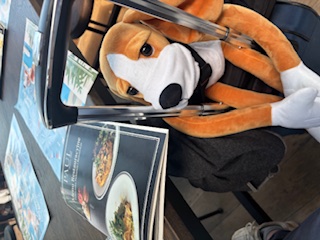
It has also allowed Inna to incorporate her medical background into her volunteer work. For each of their trips with the GVH, Inna and Sophia bring Hibuki – a floppy stuffed dog – with them. Inna jokes that, due to limited space in her luggage, she has had to board airplanes with the plushie wrapped around her shoulders. It’s a small price to pay for the importance of her mission.
In July 2025, Inna held monthly Hibuki sessions with Ukrainian parents and their children in Hamburg, Germany, through partner organization Feine Ukraine. By involving parents, Inna could teach them how to utilize Hibuki themselves after she returned to New York – building resiliency in the process. She and Sophia have also volunteered in Poland, with Sophia participating in GVH trips there three times.
Many of the families they’ve met have been separated for extended periods of time; often, it’s the mothers and children who had to leave Ukraine while fathers and husbands stayed behind to fight. Being apart from their loved ones in a strange country takes a toll on refugees’ mental health. What compounds their situation is the lack of adequate resources to help them cope. That’s what makes Inna and Sophia’s participation in the GVH so special: they are the difference that guides refugees towards healing and, later, rebuilding.
The Muntyans’ passion for volunteering hasn’t just changed the lives of the Ukrainain refugees they’ve interacted with; it’s made a mark in their own lives. Sophia is in graduate school for mental health counseling and just returned from another GVH trip to Poland. It’s an experience she says is “really meaningful” as she paves her career path.
What began as a simple desire to help ease the suffering of Ukrainians displaced by war has blossomed into a sustained commitment to bettering their mental health, with the assistance of a lovable plush companion.
Inna can sum up her experience in seven words: “Once you start doing it, you’re hooked.”