
When it comes to bridge-building, we often think of deep dialogues with prominent faith leaders or major programs involving hundreds of people. But at a time when loneliness has reached epidemic proportions – and is having strikingly negative health impacts - the simple act of learning and playing a game together can foster more enduring relationships than we might otherwise imagine.
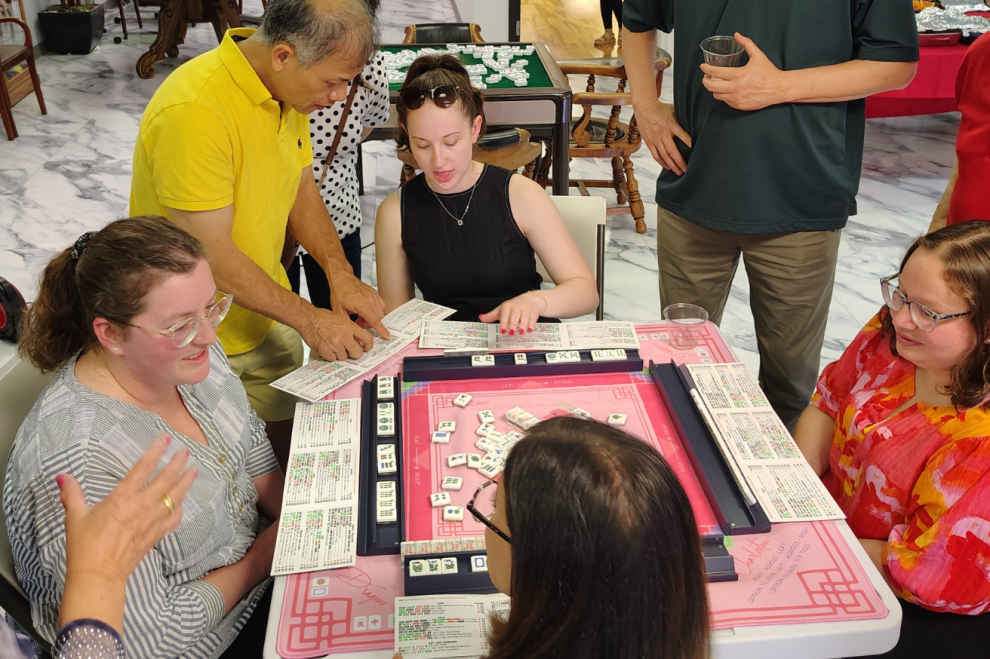
For several years now, Memphis Jewish Federation has cultivated a relationship with the local Chinese Community Center. Last spring, the Engagement Cohort of Federation’s Community Relations Council decided to try a new idea: bringing together their community members to play Mah Jongg. a game of historic and renewed popularity, especially in Jewish and Chinese-American circles. Played with four people seated at a square card table, it is defined by collaboration, friendly competition, and strategy. Over time, it gives way to easy conversation, laughter, and genuine friendship.
According to Sara First, the Community Relations Manager at the Memphis Jewish Federation, the Federation’s Chief Impact Officer, Bluma Zuckerbrot-Finkelstein, as well as several lay leaders, came to know their Chinese American counterparts through the Memphis Mayor’s Multicultural Advisory Board.
Sara, Bluma, and their Chinese American colleagues remained in regular touch about issues large and small, making clear that they cared about each other’s communities. For example, after October 7th, the director of the Chinese Community Center and one of his board members came to Federation’s gathering of support – and did so again at the one-year anniversary. Last Purim, as the Engagement Cohort delivered Misholoach manot to the Chinese Community Center, the head of the center brought up an idea: Let’s get people together to play Mah Jongg.
Initially, it started out small with eight people attending. But over the course of five meetings, it quadrupled to 32 people (in 8 groups of 4) turning out to play. Long-time participants greeted each other like old friends, with hugs, smiles, and laughter. At the same time, the conversations delved into more serious topics.
Many of the Chinese-American participants, notably the professional and lay leaders of the Chinese Community Center, wanted to know about how Jewish communities transmit language, culture, and values across generations – and how they might use similar approaches with young Chinese-Americans, particularly those born in the United States. They felt a sense of kinship as a community which prioritizes education, family, and hard work, and yet a sense of worry about successfully acculturating at the expense of identity and heritage.
Other Jewish Federations have related stories of collaboration, notably between Chinese Americans and Chinese Canadians who immigrated to the United States a generation or more ago. Unfortunately, more recent Chinese immigrants may have preconceived notions about Jews and Jewish communities from state-sponsored media in China, which have become increasingly anti-Israel and conspiratorial about Jewish influence in North America. As such, time is of the essence to counter false perceptions and build upon the positive ones which may be latent within many Chinese American communities.
While shared needs may in time point to collaborative advocacy efforts, bridge-building need not always be so serious. It can be about time shared with new friends, the collaboration of lay leaders and professionals, and even the simple joy we can find in a fun game of skill and chance.