
Jewish communities across the country are working to build coalitions around priorities such as Nonprofit Security Grant funding, locally as well as nationally.
Sometimes, we find unexpected coalition partners, who are not only allies in advocacy but true friends, with a deep sense of common cause.
Just ask Zach Schwartz, who directs the Jewish Community Relations Council (JCRC) at the Jewish Community Alliance of Southern Maine (or JCA - Maine’s Jewish Federation), and found strong allies in the Maine’s Cambodian-American community.
While there may be only 360,000 Cambodian-Americans nationally, in Maine Cambodian-Americans play leadership roles in numerous Asian-American organizations and have a long-standing sense of connection with the Jewish community.
Zach, who is himself an Asian-American Jew, finds bridge-building meaningful both personally and professionally. His mother is a Taiwanese immigrant and convert to Judaism, giving him a deep connection to both Asian-American and Jewish communities. As a current Fellow for Lunar Collective (an organization which serves and empowers Asian-American Jews), he understands that bridges of belonging can matter not only for each community and how they interact, but also for many individuals who see themselves as part of more than one.
When Zach arrived at the JCA, the Cambodian-American community was holding an event to commemorate the 50th anniversary of the Cambodian Genocide in the building. Seeing both a chance to learn and show solidarity, Zach decided to attend.
It proved to be more fruitful and personally meaningful than he could have imagined.
At the commemoration, Zach struck up a conversation with a local Cambodian-American leader, Marpheen Chann. That one conversation sparked a series of interchanges, which in turn blossomed into a personal friendship and a professional collaboration.
Their relationship has already borne fruit.
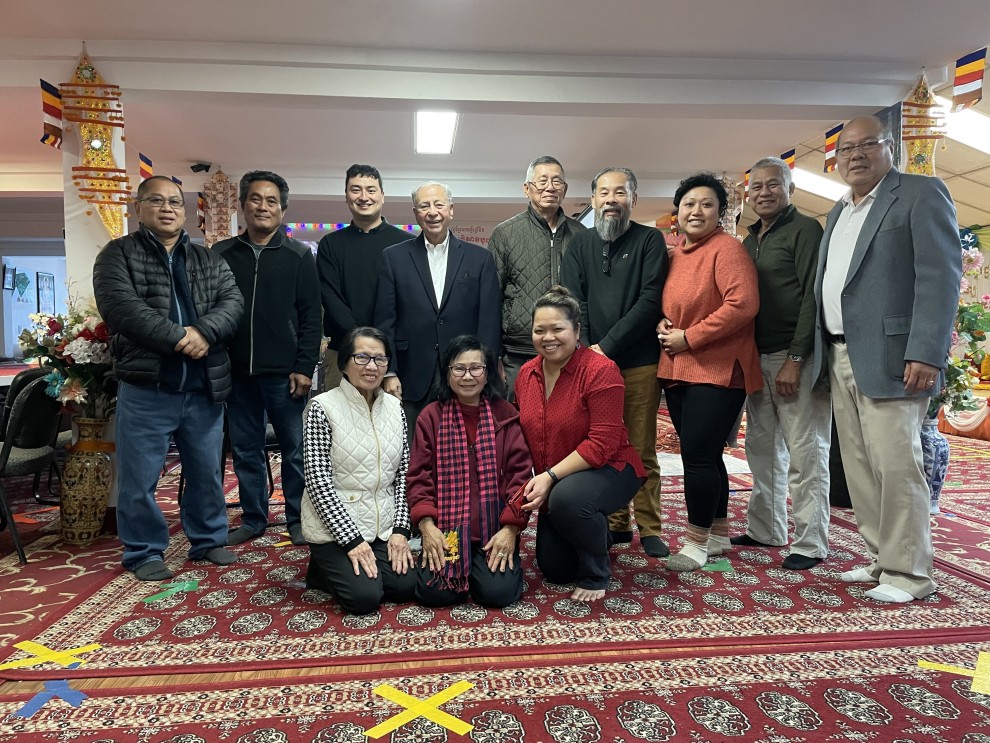
This past August, Zach and Marpheen launched what is now known as the Jewish-Asian Friendship Dinner. The inaugural gathering brought together Jewish leaders with Cambodian-, Chinese-, and Filipino-American leaders; it has since seeded numerous collaborations and a deeper sense of friendship.
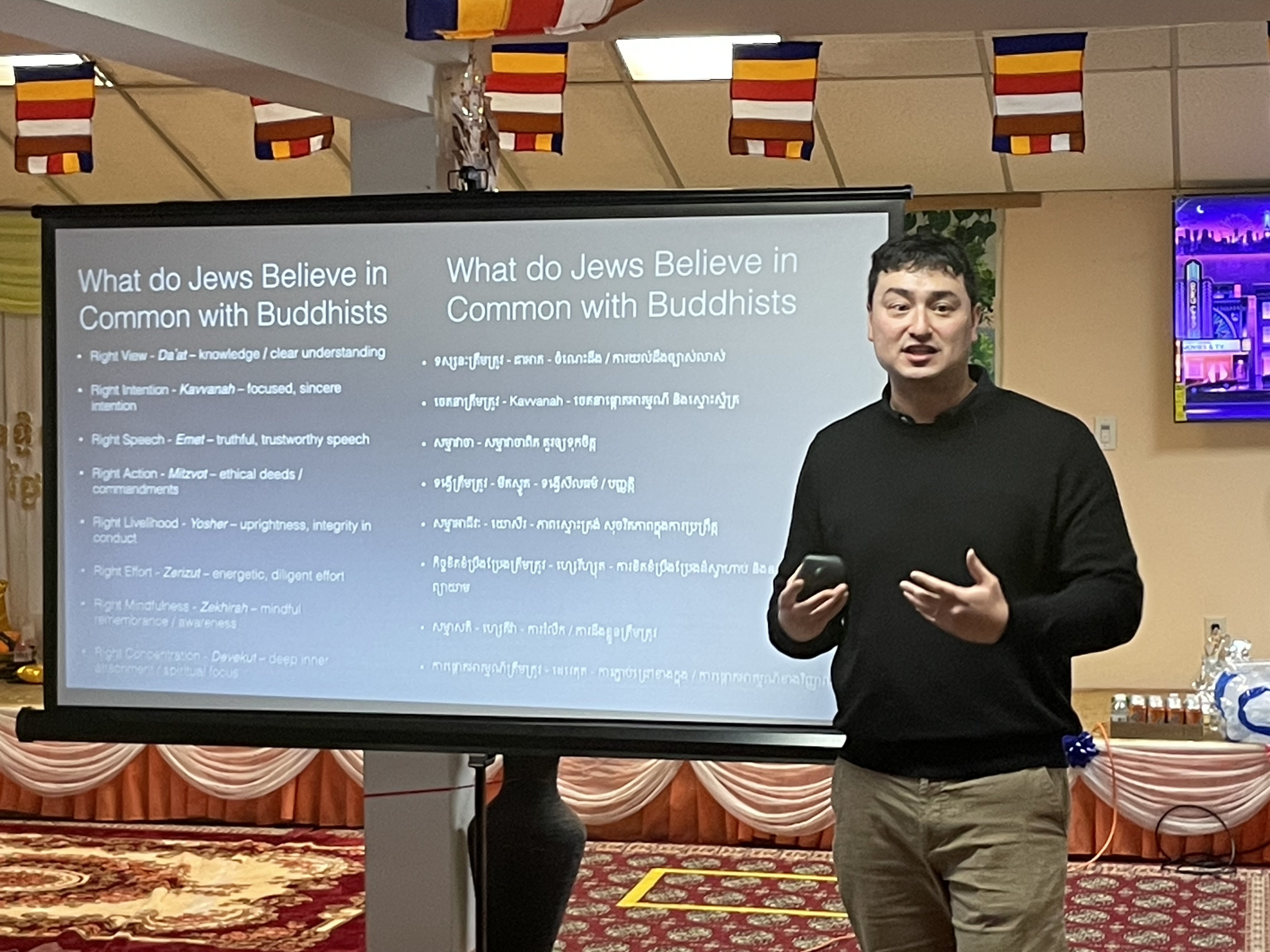
Most recently, Zach presented on the history of Judaism before an audience at the Watt Samaki Buddhist Temple—the largest Buddhist Temple in Maine and spiritual home for many Cambodian-Americans. He didn’t just talk at the participants; the event fostered deep conversations and soulful storytelling from both communities because of the sense of kinship they feel for one another. Pain and resilience after great loss underscores life for Jews and Cambodians, including those communities in southern Maine.
The relationship has grown beyond dialogue into shared community programming, including an upcoming cybersecurity training for both Jewish and Cambodian elders made possible by Jewish Federations of North America’s Emergency Security Fund in partnership with The Tepper Foundation.
Zach currently is focusing his energies on growing his JCRC’s Intercultural Corps, which works to build bridges across communities. The Intercultural Corps was established last fall and already has 20-plus members. Not all members are Jewish—one JCRC member belongs to Maine's Tutsi community—but all of them seek to build bridges between Jewish and non-Jewish groups: for example, the Intercultural Corps recently tabled at Maine’s biggest Chinese New Year event.
Zach’s story of compassion led to real friendship; that friendship led to storytelling and a sense of common experiences. That commonality, in turn, has informed advocacy efforts. Zach recently celebrated a major statewide legislative milestone, organizing and leading an interfaith, intercultural coalition to increase Maine’s non-profit security grant funding which has been making news in Maine.
Zach attributes these relationships to the work of Professor Abe Peck, a renowned scholar of genocide, and his efforts to reach out to Cambodian-Americans locally. They also owed to the efforts of Sam Cohen, Director of Operations for the JCA, who nurtured relationships with Cambodian leaders. Likewise, one of the first physicians who tended to Cambodian survivors of the killing fields decades ago was a Jewish community member, Dr. Larry Kaplan. These and other lay people wove together strand after strand of relationship.
The Cambodian-American community might comprise only one percent of the Asian-American population nationally, but it has an outsized place in Zach’s heart and that of a growing number of Jewish lay leaders and professionals across Southern Maine.